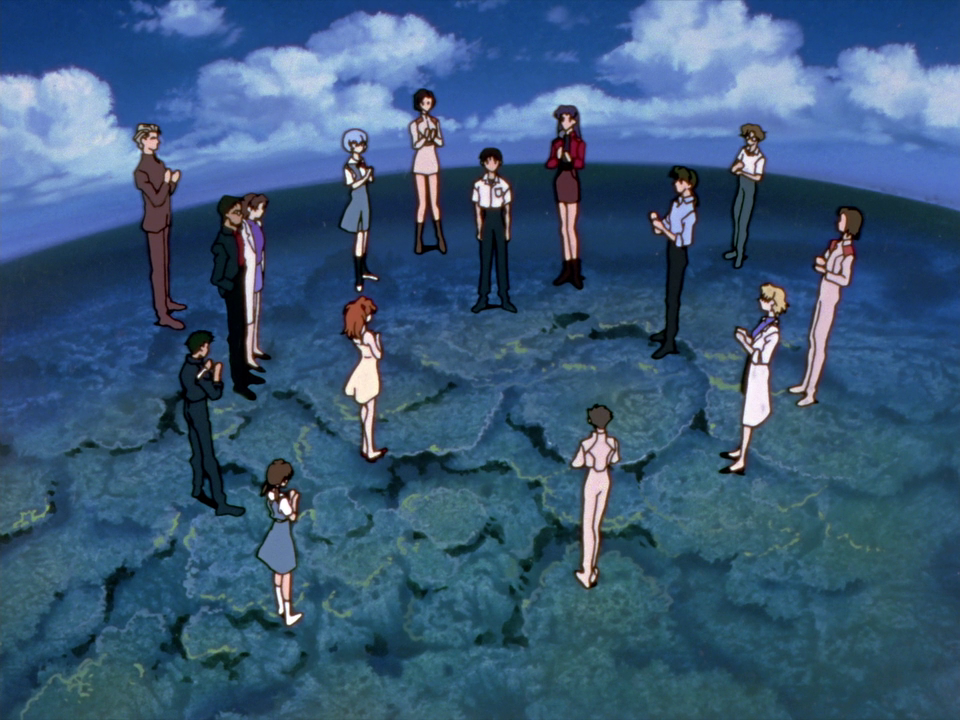
The first chapter after Hell Screen is Dr Ogata Ryosai: A Memorandum. I'm skipping it though, because i didn't understand it :[
The one after that is called- woah did you guys see that
catch that horse!!! it'll come back round, and when it does, click on it! i need it stable! i mean. you know what i mean.
Anyway, where was i... after Memorandum is The Story of a Head That Fell Off.
The Story of a Head That Fell Off [13 pages]
For a name so derelict of meaning, the prose in this piece is Beautiful. The man in question, named Xiao-er, dies without much fanfare, but the scene he creates as his mind dies is described so wonderfully. Perhaps it's because he died honorably- riding into battle clashing with the enemy commander atop a horse. No better way to go out in a soldier's mind. As he dies, he looked back on his life, as his mind is overtaken by the "ugliness that filled it". If I escape death today, I swear I will do whatever it takes to make up for my past, he says. Which is why it's great when he *does* come back to life, and fucks it up.
Akutagawa does something great here. He switches the focus *completely* to a different time, place and person. It's now been a year, and the war is over. We're focusing on some military men discussing naturally, when a news article comes across the table describing the debauchery of a local alcoholic man known for womanizing. He got into a bit of a fight, where the strangest thing happened. His head fell off. A reopened wound on the neck. What a waste of a beautiful moment. All that hope he had, only because he was afraid of death. A failed little promise to the universe.
We aren't granted the view to his internal monologue when he dies in the bar. It's just skipped over. One can only imagine him making the same wish, asking for another chance. Remember though- we're on a trail of unreliable narrators. This is a brilliant way to show that even omniscient narration can be fucked with if it's following one guy's thoughts. Everything the narrator said was true- but it was based off of Xiao-er's world view, one biased by the icy grip of death.
Horse Legs [21 pages]
I'm not reviewing this one, I fucking HATE horses. Fuck those long-faced pieces of shit. All they do is eat hay and jump over hurdles- I CAN DO THAT TOO!!!
Death Register [9 pages]
It's just a list of dead people. A story about a man going through life as his family dies. At the end, the man says "I don't much like visiting the cemetery, and I would prefer to forget about my parents and sister if I could".
I think it's good to remember the dead. We can watch the memories in which they lived. That's worth the pain of grief, but the man has given up. I think life had beaten the sympathy out of him.
The Life of a Stupid Man [30 pages]
This is where a pivotal switch occurs: for every part of this and the last chapter, we follow Ryunosuke Akutagawa, the writer himself. Thus, he is the stupid man, and it is his life.
As a sort of microcosm for the book as a whole, this chapter is split into many different stories, in this case, 51. Some are so small it'd be okay to call them poetry, and even the big ones aren't longer than a page. Each has a title of a single word.
Before the stories start, there's a little letter addressed to Kume Masao- a friend of Akutagawa's. He describes how utterly depressed Akutagawa is, "living in the unhappiest unhappiness imaginable". It reads as if he will never write anything more, like he won't be around to even publish this. Sure enough, there's nothing fictional about this letter. Though it's ambiguous whether this is the note accompanying his first or second attempt, it's certain that he wrote a suicide letter to Masao, and this is it. At the end of the letter, the last words the writer may have ever wrote, he says: "I may wear the skin of an urbane sophisticate, but in this manuscript I invite you to strip it off and laugh at my stupidity".
The following 51 stories paint a picture of a deeply confused man pestered and harassed by the outside world, but with a profound interest in the arts. Akutagawa's imposter syndrome is palpable- he literally name drops all the authors he thinks he is imposting. Even philosophers like Nietzche and Dostoevesky get mentioned several times. It's worth mentioning that Nietzche coined the phrase "God is dead", and famously rejected nihilism as a retort to theism. Perhaps the positivity and beauty that Nietzche brought forth in his philosophy made a man as depressed as Akutagawa jealous. There's a weird cultural perception for jealousy as a childish ugly thing, but the jealousy of others that can emerge in the depths of depression is common and natural. Being depressed can feel like you are so alien to the human experience, you're a creature of some sort. It's this personal distance to the "big other" that reinforces the depression that created it, and something that Akutagawa's work reeks of. It really underlines these later stories, and especially Spinning Gears.
When you feel so apart from the souls of others like that, so distant to the human experience, it becomes easier to align yourself with nature. As you lose all feeling, empathy for others especially, you ironically start empathising with the uncaring universe itself- and as such, almost every single one of these stories includes some gorgeous metaphor centered around reality that reflects the human condition, or the psychology of the story. Here are but a few, each being it's own little metaphor for Akutagawa's life. I've put the number and name of the story before the quote itself. It's this chapter that really cements Akutagawa as the greatest of the modernist short story writers.
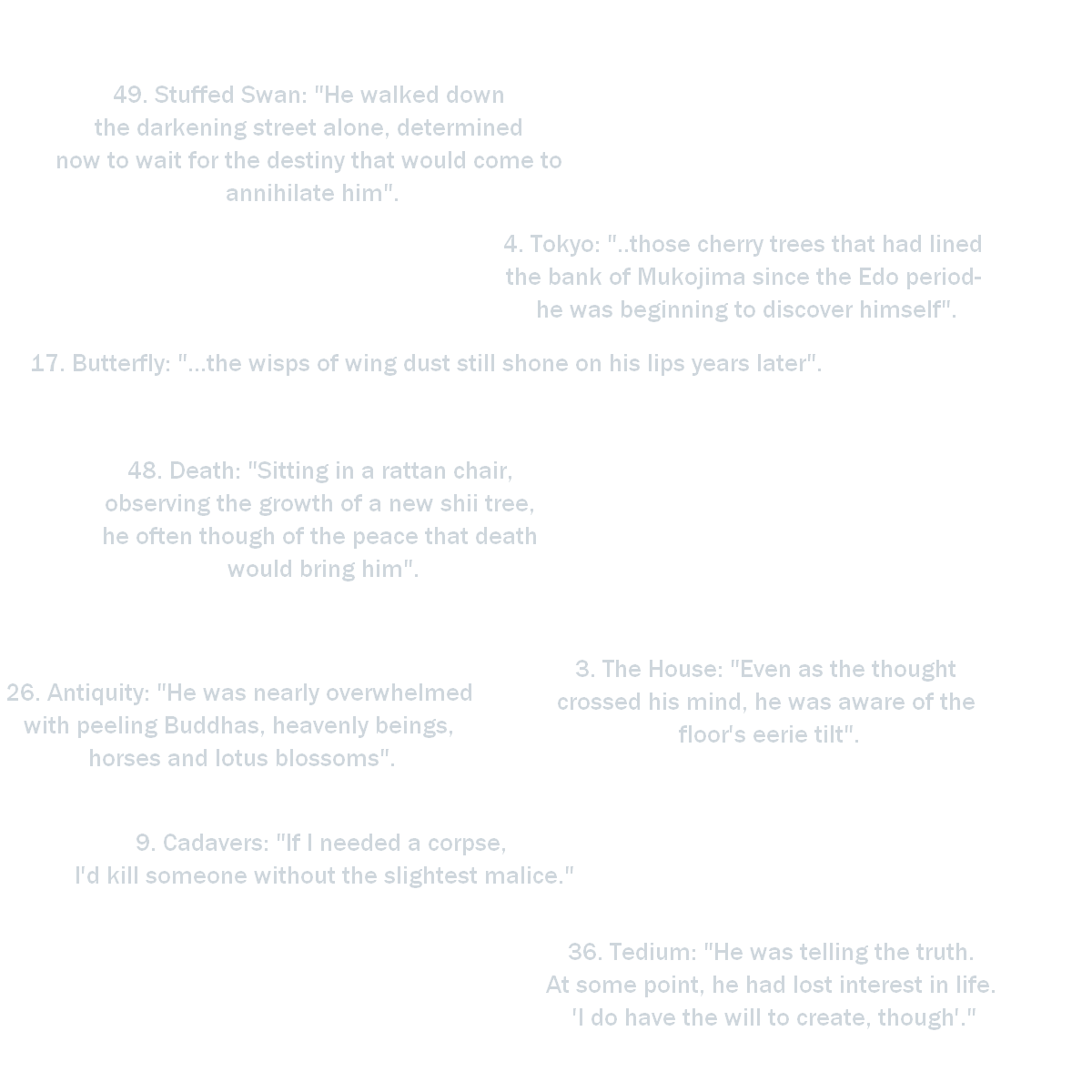
The 51st story, the final one, is titled "Defeat".
Spinning Gears [44 pages]
Spinning Gears [44 pages]
Spinning Gears [44 pages]
Spinning Gears [44 pages]
Spinning Gears [44 pages]
Spinning Gears [44 pages]
Spinning Gears [44 pages]
Spinning Gears [44 pages]
Spinning Gears [44 pages]
Spinning Gears [44 pages]
Spinning Gears [44 pages]
Spinning Gears [44 pages]
Spinning Gears [44 pages]
Spinning Gears [44 pages]
Spinning Gears [44 pages]
Spinning Gears [It's been 3 months.]
Writing is hard. Van Gogh killed himself, Julia Acker killed herself, Kay Sage, Nicolas de Staël, etcetera, etcetera. Hideaki Anno once said "Well, it didn't lead to my death, and so I'm here," a quote I find appropriate to be used at any time for any event- but in the end, it is me whom the woe is upon. I am the one who suffers the most of all of them, because I want to write a little analysis on these storied authors whom have written libraries.
Ryuonsuke Akutagawa, you might have shortened my writer's block had you wanted to live. That would have been so convenient, and had the unintended consequence of making all your work dull. Fortunately, Akutagawa killed himself, and I am going to tell you why- but only after a related side-tangent.
I am, first and foremost, a physicalist. I think the hard problem of consciousness is easy, and reality looks like a vector field with infinite detail. This might be due to my young naivete, but I keep getting older and the world is obviously only getting simpler- so everything will make sense eventually! Half of that sentence is sarcastic, but it does present an interesting juxtaposition. Considering how absurdly confusing the world the world you and I live in is, why can individuals be so sure of physicalism?
FAITH. YOU ARE ASKING A QUESTION OF FAITH. A PRIEST AND A QUANTUM PHYSICIST WALK INTO A BAR- ONE ASKS THE OTHER: "HOW CAN YOU BE SO SURE?"
Reality is up to interpretation, but reality *is*. By that fact, we must trust the sciences. When magic appears, we ask the epistemologist how it works- and they tell us that it *is*, and therefore there is a science by which it *works*.
That's why when I watch Doctor Who, I enjoy it :).
READER, UNDERSTAND MY WORDS: THE SUPERNATURAL IS SCARED OF THE OBJECTIVE WITNESS THAT FICTION PROVIDES. WHEN THE DOCTOR TALKS OF SILLY ENERGIES AND JUMBO QUARKS, THE VIEWERS KNOW HE IS NOT LYING- AND THUS WE ARE SCIENCE. BY SEEING THE PHENOMENA, DOES THE EXPLANATION BECOME SECONDARY. THAT IS THE NATURE OF HUMANITY."
Spinning Gears [Losing it a bit, are we?]
Only on paper. I bring all this up, because we can never create the same observer fiction does. Stories make this little word in which their word is law; and since our world is godless (look it up, it's true!) then we can never be sure of anything. If only we had the objective word of a God, just to say, "Keep truckin' on guys!"
Anyway... I'm permitted to lose my mind once per review. Spinning Gears is composed of six stories, the first of which is called: Raindrops. In which, Akutagawa is haunted by a little story of a ghost who wears a raincoat. It's a little cute, isn't it? Childish enough to disregard, and such is Akutagawa's initial reaction. After being told of it, he gives a nothing-response 'half-hearted'ly. Then, it's stated he "stared across to where the western sun struck a pine-covered hill". Good prose, but it's placement is definitely meant to flag to the viewer Akutagawa's physicalist views. It's like someone gives you a quart of holy water as a funeral gift- and when they turn their back, you chug the whole thing.
His normal life continues, with him becoming challenged more and more by this ghost story. Things keep happening, culminating in his sister's husband being killed by a train- while wearing a raincoat.
Now, IS IT SO ODD TO WEAR A RAINCOAT? No, of course not. Writing a story based on real events is all about showing the viewer a narrow slice of what You think is important. In this case, it's clear how much Akutagawa is cherry picking. He knows in his heart of hearts that ghosts- well, it's actually beyond ghosts at this point, isn't it? It's simply the fact that his sister's husband was *wearing* a raincoat- aren't real.
Back in University, I got so anxious about all the bad things that I started having delusions. I would see things- cherry pick my subjective interpretation of reality. I grew a fear of similarity. One time I saw three cranes right next to eachother, and it kept me up for weeks. This fear was because I felt like the "universe was watching me". I humanized the terrible, unlucky things that happened to me because it gave me hope, that one day this villain would stop toying with me. And when I saw those cranes, or a particular string of lights, or 16 croissants at the bakery lined up in a 4x4 square- it was one of his eyes, keeping me ensnared. My plight was of too many things happening. To Akutagawa, the exact opposite occurred. I suspect he found such intense misery in his life because nothing happened. He desperately wanted that word of God- that objective viewer of fiction to tell him that his abstract thoughts were Good! After all, he wrote for years, and he never met the same success as his heroes. As the stories go on, and on, and on, and he hallucinates spinning gears more and more- it becomes clear how alone he is. He pushes everyone away- his family, when they aren't dying, never check up on him. The most human interactions he has are these little lonely small-talks he has with his coworkers.
All of this apathy, and for what? The world was still confusing. I don't know what to look for in Akutagawa's writing because he never figured it out himself, and THAT'S what plagued him. The philosophers seemed airtight and invincible, oh they knew what was going on, but him? Just a man. He existed in this world in the same way a rock does- unthinking. How could a writer live in a world without meaning, and especially one that was so cruel to him? The gaping hole in his heart- a hole initially torn open, not by existentialist dread, but by actual genuine misfortune. That's what
Death Register [9 pages]
was all about. You just can't grieve forever. You can't. Even if people keep dying. and as if he was a writer writing himself (he does literally do this), he looked for the conclusion to his arc and found nothing. Because there is no meaning to life. Really, it's a stupid question. We're all just quantum mechanics. This is Absurdism- the school of thought that there is no meaning to this world, and it's absurd to search for it.
So how do you beat that? Albert Camus, a french philosopher whom coined the phrase "One must imagine Sisyphus happy", believed there are THREE ways to respond to Absurdism.
Option 1: Kill Yourself
Um. Ok don't do that. What else do we have?
Option 2: Leap of Faith
This includes finding meaning in artificial systems. This is religion. I think I've talked on this one enough in this review... suffice to say this isn't good either. In fact, Camus called this "philosophical suicide". What's option 3?
Option 3: Acceptance and Revolt
Now we're talking. Embrace the meaningless of the universe. Accept in it's entirety, and then revolt against it. Fuck you universe! Fuck you!!! I will live passionately in spite of you. Happiness requires no meaning. The chemicals in my brain love this purpose, and will keep me whole. This is what Ryunosuke Akutagawa needed. This could have saved him.
In the end, he did choose option one. I think that's simply a testament to the overwhelming power of pessimism. It deludes you, into thinking raincoats are haunting, or moles are angry, or that you are simply a spinning gear in the machine in the world- and that's somehow bad. The human brain tells us the physicalist interpretation is sad! Just a cog in an endless machine, and if you were gone, the world would spin without you. But think of the museum, allow yourself to walk around it's halls- with walls full of empty frames. Every frame, pedestal and case void and untitled, with all the art that we could have had, had they lived. Akutagawa should have written more of love, and less of how unloving the universe really is.
Overall, analyzing Akutagawa can be a gift. He gives you the omnipotence that being the reader provides- a logically airtight escape from absurdism. An objective set of answers to the world. Akutagawa is trying to trick you into believeing he really is just plain insane and stupid- as he questions existence with these vague synchronicities. However, as if he forgot it himself, there are nine stories preceding this one that testify as to the unreliability of the narrator. This chapter, being embedded the most in reality, invites the reader to question the author himself. There's a sick sense of positivity in that. It tells us that maybe, deep down, Akutagawa was aware of his greatness, and could only hide it in folds of narrative meta-brilliance.
In our modern day, it really is important to do the cliche and silly. The part of you that cringes is simply an evolved sector of the brain that maintains "reputation"- and enforces a fear of the generic. Do kill that part- so long as your priorities are right (writing what you want, for you and yourself as the audience) then all will fall into place. You will make it- and I wish Ryunosuke Akutagawa could've made it too. Had he wrote more text of love, there could've been a chance- but there is so little. There is so little, that I struggle to analyse it. We never met Yoshihide's wife, and I wonder why?
I think Akutagawa struggled to write of human love because he believed of those physicalist views. He wanted the universe to love him, but he was a nihilist. The thing he didn't realize, in a whole life's ponderings, is that it did. By existing, the love is implied, and the explanation comes secondary. When the universe's eye is apparent through those little synchronicities, that is it popping in to say: "I love you". That's the best you're going to get from the universe- for, if we are to personify it- the universe is nihilistic too. It does not tell us of it's love, but implies it, through every chemical reaction in your body that makes up the "you". Physicalism is not the chasing of scientific truth- the truth is already here, proved by our existence, and that is what love from the universe looks like.
So many things I never mentioned... at some point, this was a review of a book... all in all, Hell Screen is brilliant. I struggle to define "quality" these days- but Hell Screen certainly gave me a lot to ponder about, so let's just say
10/10